Sardinia, where every coast tells a different story
Sardinia has long been loved as one of Europe’s favorite beach destinations. Today, as the island continues to attract travelers from all over the world, its coastline reveals itself as far more than a summer postcard.
It is a world of contrasts. Limestone cliffs falling into transparent waters. Red porphyry rocks glowing at sunset. White quartz beaches, wild dunes shaped by the mistral, hidden coves accessible only by sea, and islands where nature still feels untouched.
With Sardinia My Way, we invite travelers to discover this extraordinary diversity through a more intimate, curated and authentic lens — from the island’s most celebrated beaches to those known only to a few.
The eastern coast: where cliffs meet the sea
Recently, Cala Goloritzè and Cala Mariolu, two jewels of eastern Sardinia, were officially listed among the “Best of the Best” by The World’s 50 Best Beaches, a Hall of Fame dedicated to beaches that have previously ranked No. 1 or have received special recognition among the world’s most extraordinary coastal destinations.
Located in the Ogliastra subregion, within the spectacular Gulf of Orosei, they belong to one of the island’s most breathtaking coastal landscapes: a sequence of coves that can be reached only by sea or through trekking routes across the mountains.
Here, places such as Cala Luna, Cala dei Gabbiani, and Cala Sisine define this stretch of Sardinia’s coastline, with limestone cliffs plunging into crystal-clear waters. The contrast between white rock, green Mediterranean vegetation, and the deep blue sea creates a vision that feels almost unreal.

Cala Goloritzè
The south-east: golden sands and relaxed atmosphere by the sea
The incredible uniqueness and variety of Sardinia’s coasts come from its diverse geology, which changes from one area to another.
Travelling south from the Gulf of Orosei, where limestone dominates the landscape, the scenery begins to shift towards the red porphyry rocks around Tortolì and Arbatax. Here, beaches such as Cea and Perdepera stand out for their turquoise waters, creating a striking contrast with the surrounding landscape.
Further south-east, Sardinia welcomes travelers with the wide golden beaches of Costa Rei and Cala Sinzias, more than two kilometers of coastline characterized by clear, transparent water and a gently sloping sandy seabed. This makes the area particularly suited to families, slow beach days and a relaxed atmosphere by the sea.
This part of the island is also a favorite destination for travelers looking for more adventurous experiences. For those who love extreme sports, skydiving from 4,000 meters offers a truly mesmerizing perspective over the south-eastern coast, where the island’s colors open below in a spectacular encounter of sea, mountains and light.
Only a short drive away, the color of the coastline changes once again, giving way to the long stretch of soft white sand at Porto Giunco, near Villasimius. Enclosed between the lagoon and the sea and nestled between promontories that act as a natural defense from the winds, Porto Giunco offers one of the most iconic views in southern Sardinia.
The beach is part of the Marine Protected Area of Capo Carbonara, home to a variety of small and large beaches set among granite crests and transparent waters. Among these pearls, Punta Molentis stands out with its delicate half-moon shape, framed between two strips of land.
Between the Marine Protected Area of Capo Carbonara and the city of Cagliari, the south coast is dotted with enchanting beaches that make every drive by car or motorbike a feast for the eyes. Mari Pintau Beach is a perfect example: a place where the name itself, meaning “painted sea”, evokes the intensity of its colors.
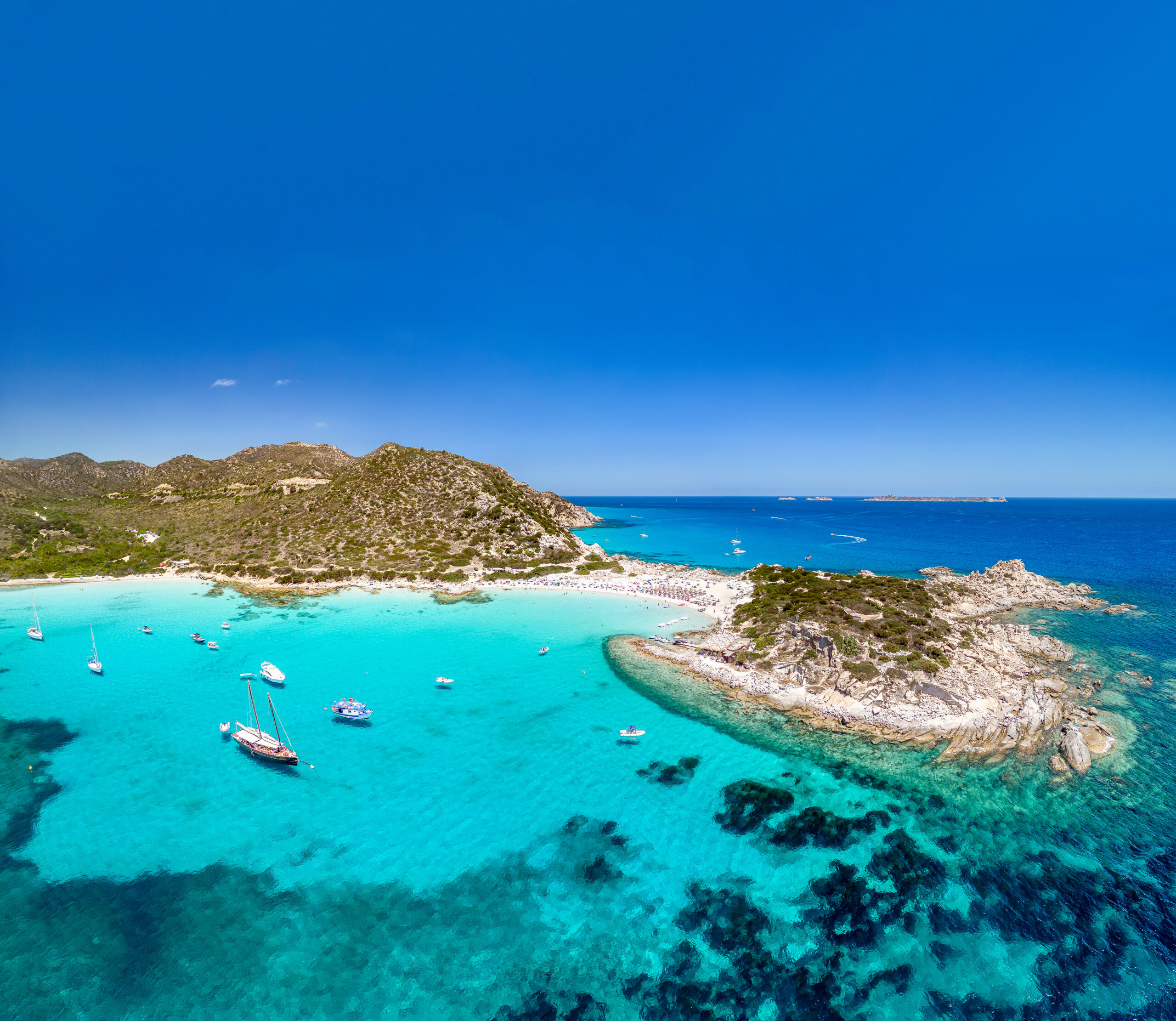
Punta Molentis
Cinematic landscapes of South West Sardinia
South-west of Cagliari, where the island reaches its southern tip, beaches such as Santa Margherita di Pula, Su Giudeu, and Tuerredda showcase the soft side of a coastline framed by mountains.
This area has served as the setting for several commercials thanks to its spectacular scenery and the vivid contrast between the water, the green Mediterranean vegetation, and the delicate golden tones of the fine sand.
Further along, the dunes of Porto Pino surprise travelers with sand so soft and white that it almost feels liquid. Nearby, Maladroxia Beach, on the island of Sant’Antioco, faces the opposite coast of southern Sardinia, where the Porto Pino dunes stand in the distance.
From the south-west to the north-west, Sardinia reveals another side of its beauty: wilder, more dramatic, more sculptural. Many stretches of this coastline can only truly be discovered by sea. Sailing along these shores unveils untouched corners that remain invisible from the mainland, making the journey itself part of the experience.
At the same time, travelling along these coastal roads by motorbike offers one of the island’s most spectacular adventures. Curving roads suspended between mountains and sea open onto breathtaking panoramas at every turn.
Masua and Cala Domestica — a deep inlet resembling a fjord — reveal a more dramatic landscape framed by imposing cliffs and the remains of ancient mining sites, which make this part of Sardinia unique.
Rising from the sea, Pan di Zucchero stands as one of the island’s most impressive natural monuments: a 133-metre-high sea stack, symbol of the south-west coast, reachable by boat and renowned as a remarkable climbing destination.
Along the Costa Verde, nature becomes immense. Scivu Beach, the imposing dunes of Piscinas — a UNESCO-recognized natural area — and Torre dei Corsari appear almost desert-like, where warm golden dunes shaped by the mistral wind extend for several kilometres from the hinterland before diving into the boundless shimmering blue sea.
Here, nature dominates completely, offering travelers a sense of isolation and freedom rarely found elsewhere in Europe.
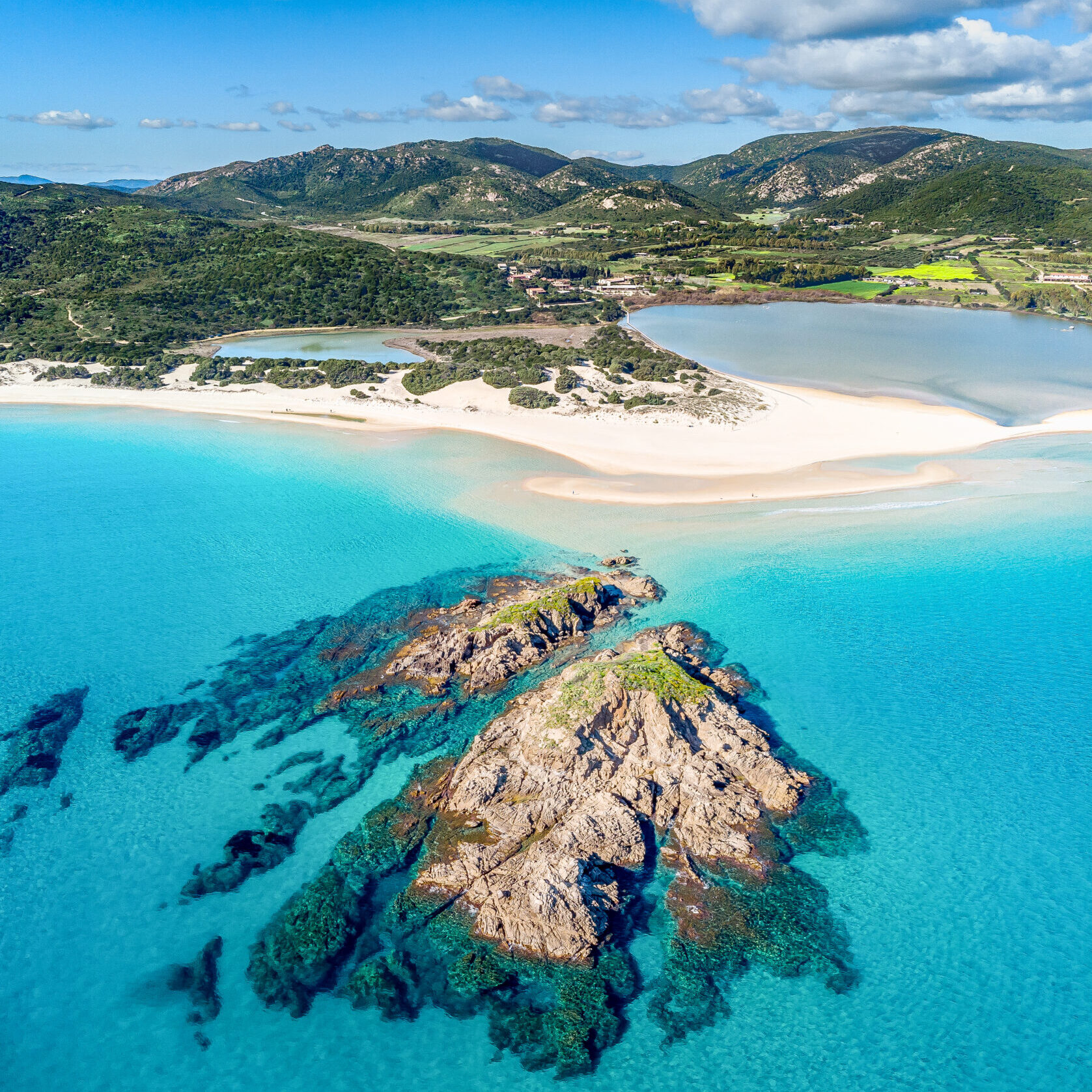
Su Giudeu
The West: quartz beaches and geological wonders
In central-west Sardinia, within the Marine Protected Area of the Sinis Peninsula, the landscape and geology change completely.
The beaches of Maimoni, Is Arutas, Mari Ermi, and Isola di Mal di Ventre — a flat granite islet lying just offshore — are all part of this extraordinary ecosystem, where quartz beaches shimmer under the sun in shades ranging from white to pink and emerald green.
Further along the central north-west coast, the island’s scenery changes once again. S’Archittu enchants visitors with its natural limestone arch carved by the sea, while Cane Malu surprises travelers with its natural pool sculpted into volcanic rock.
Around Alghero, the coastline opens onto some of north-west Sardinia’s most beloved beaches, from Le Bombarde to Mugoni, close to Capo Caccia and Porto Conte Bay. This regional park and marine protected area is particularly appreciated for snorkeling and diving activities, together with dolphin- and whale-watching experiences.
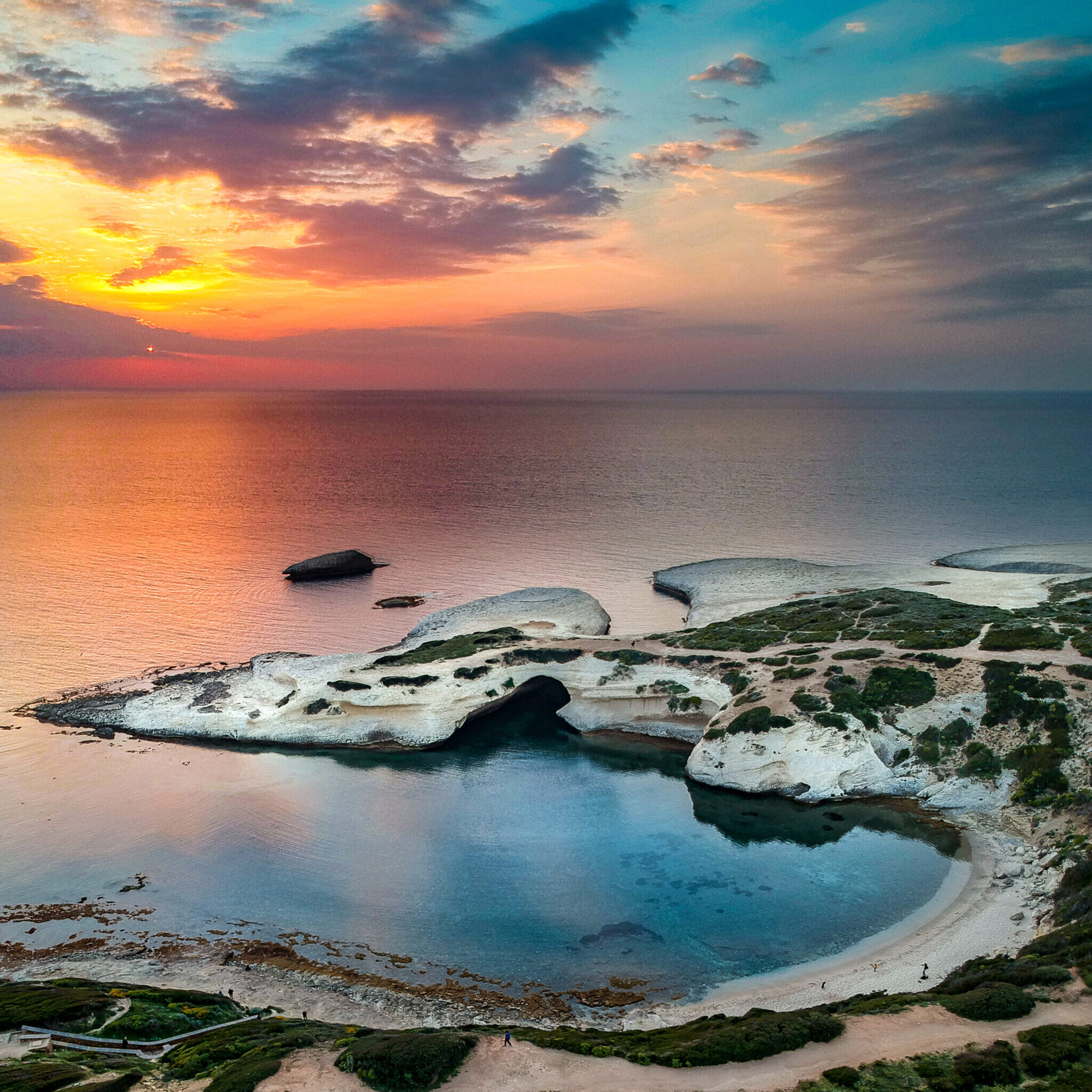
S’Archittu
The north-west: turquoise waters and untouched islands
At the island’s north-western tip, La Pelosa captivates travelers with its turquoise, crystal-clear shallow waters and incredibly fine white sand, creating colors that are almost Caribbean-like. The beach enjoys particularly calm waters thanks to the natural barrier formed by Asinara and Isola Piana just offshore.
Asinara itself, once a high-security prison and now a national park, preserves an authentic and untouched beauty. Cala d’Oliva and Cala Sabina, with their crystal-clear waters, are among the highlights of the park, which is home to more than 80 animal species, many of them rare, endemic, and protected within the island’s unique ecosystem.
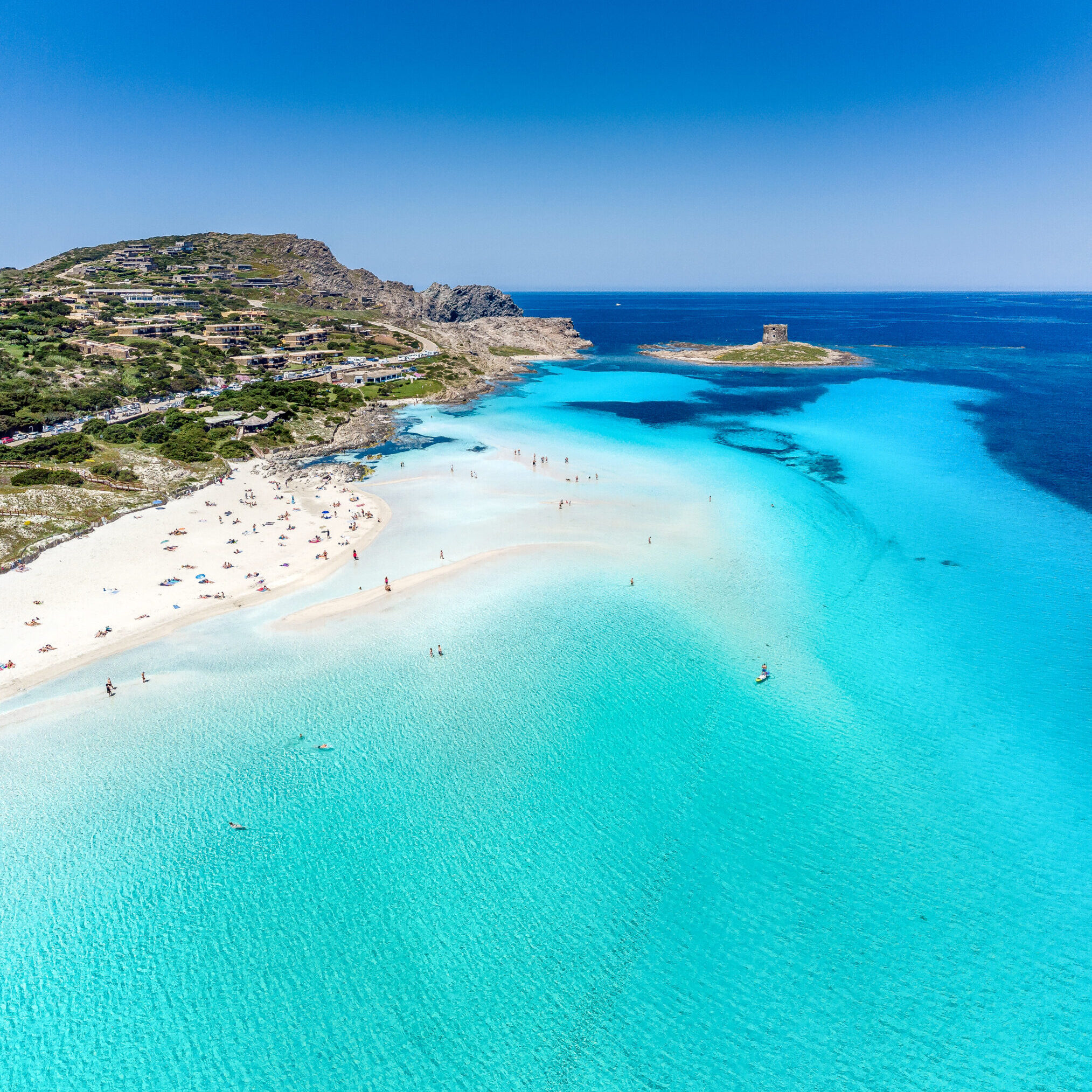
La Pelosa
The north-east: islands, granite and iconic elegance
Driving east along the northern coast, Isola dei Gabbiani has become an iconic destination. Connected to the mainland by a thin strip of sand and surrounded by constantly shifting shades of blue, the area is especially popular with windsurfing and kitesurfing enthusiasts thanks to the strong winds that sweep across this part of Sardinia.
At Sardinia’s north-eastern tip, the La Maddalena Archipelago is one of the island’s most famous treasures. Protected within the Parco Nazionale dell’Arcipelago di La Maddalena, beaches such as Cala Corsara, Cala Soraja, Cala Granara, Cala Coticcio — nicknamed the “Tahiti of Sardinia” — Spiaggia del Relitto, Spiaggia Rosa di Budelli, and Cala Santa Maria appear almost suspended between reality and dream.
Granite rocks sculpted into extraordinary shapes, secluded islands, and waters so transparent they seem painted make this one of the most extraordinary marine landscapes in the Mediterranean. Exploring these islands by boat allows travelers to fully appreciate the beauty of this marine paradise while respecting the delicate balance of a protected environment.
Around Porto Cervo, Porto Rotondo and Golfo Aranci, Sardinia combines natural beauty with refined seaside living. Beaches such as Grande Pevero, Capriccioli, Liscia Ruja, Cala Petra Ruja, Rena Bianca, Ira Beach, Marinella Beach and Cala Sassari are among the best-known beaches of the area, enriched by beach clubs and framed by Mediterranean vegetation.
South of Olbia, the landscape softens once more around Porto Istana, the natural pools of Molara, Capo Coda Cavallo, Cala Brandinchi, Lu Impostu and La Cinta, all part of the Marine Protected Area of Tavolara. Here, shallow waters and fine white sand create endless shades of blue.
And finally, near the northern edge of the Gulf of Orosei, Berchida Beach and the oasis of Bidderosa offer yet another expression of Sardinia’s natural beauty. Composed of five dream coves nestled within an 860-hectare park largely covered by woods and Mediterranean scrub, Bidderosa is peaceful, protected and deeply Mediterranean.
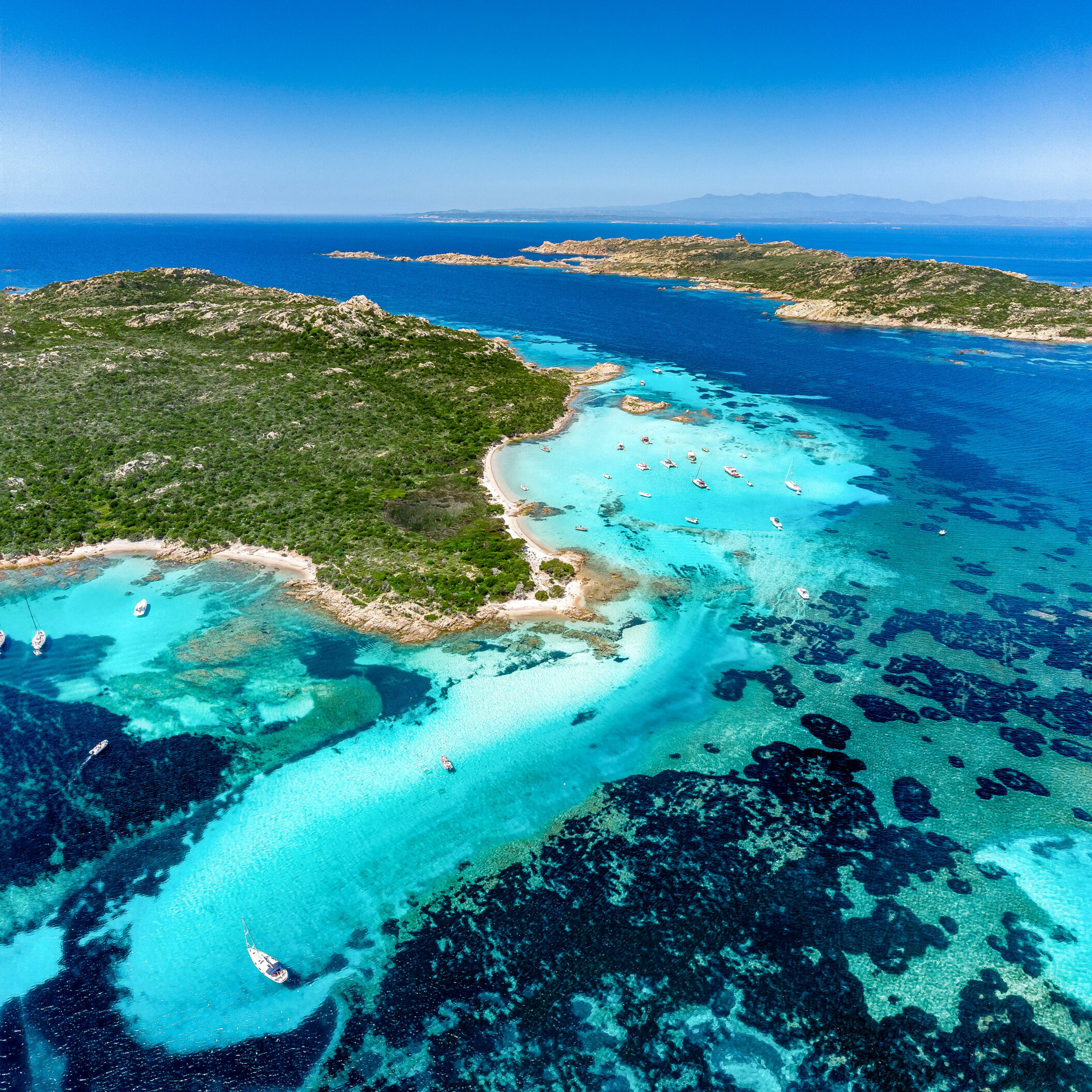
Budelli
Not one coastline, but many
This is what makes Sardinia truly unique.
Not one coastline, but many. Not one kind of beauty, but an ever-changing dialogue between rock, sea, wind and light.
From limestone cliffs to volcanic rocks, from wild dunes to sheltered coves, every stretch of the island’s coastline tells a different story.
With Sardinia My Way, each journey is designed to reveal the island beyond the obvious: the celebrated icons, the hidden shores, the private moments, the best way to reach them, and the stories that make every place meaningful.
Because in Sardinia, the sea is never just the sea.
It is a way of discovering the island’s soul.